The Contingent Dilemma
The Contingent Worker Programme Lead is a role that wears and has to swap multiple hats.

The Contingent Workforce Programme Lead sits at the intersection of HR and Procurement. One discipline hires people. The other buys things. CWP leaders are asked to do both... while belonging to neither.
In this newsletter we talk about both procurement and HR. And this oddity of a third circle of the Venn diagram called CWP that operates like procurement but also acts like HR with a focus on talent. Speaking to 20+ companies anedotally, its a conundrum of tactical vs stratey in nature.
If you report to Procurement, you're expected to negotiate rates, manage suppliers, and drive cost savings. If you report to HR, you're expected to understand talent strategy, worker experience, and organisational culture. Most CWP leaders report at mid to category level Procurement or HR. None report to the C-suite.
The result? A vital strategic role trapped in an operational box. One lead of the largest 'programme' said to us
"Conversations are constrained and whitepapers and research from Industry bodies sound lofty and important but we are never given the budget to execute it. We can't even get a good freelance marketplace initiative off the ground. We just keep saying the same thing each year"
 Jamie Gannaway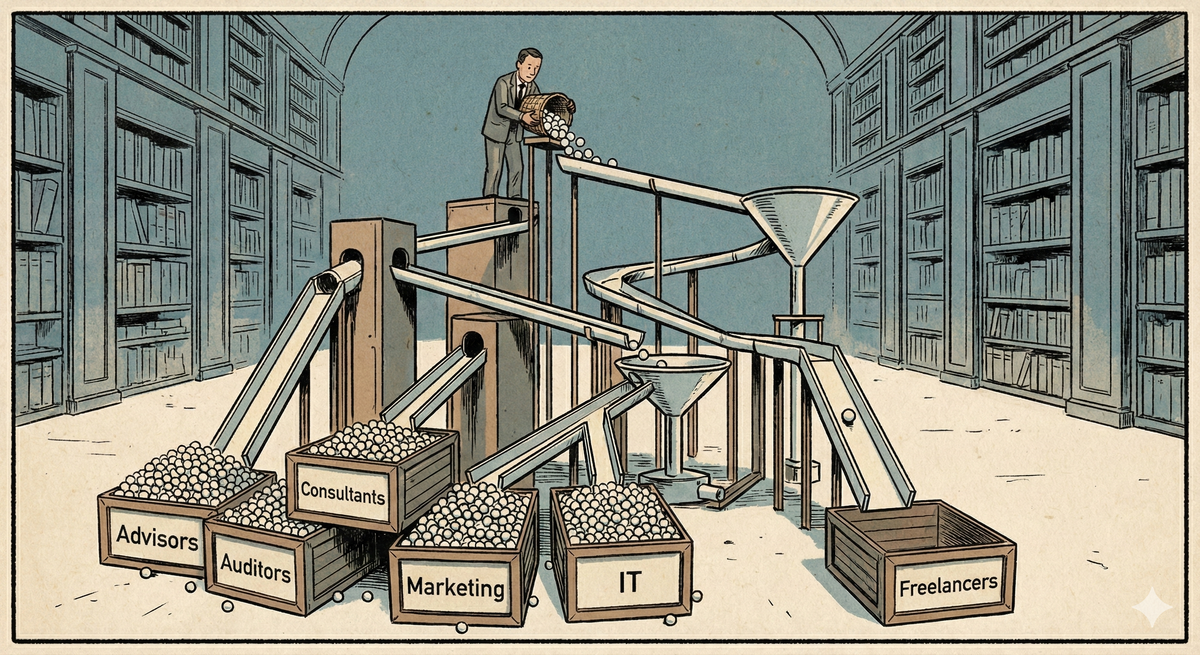
Mary and I disagree on where the CWP leader should sit. The world of HR, as Mary sees it, has always been about people. Regardless of how they're classified: "A contractor working alongside your team for 18 months isn't a 'purchase order.' They're talent. They need onboarding, they need clarity, they need to feel part of something."
Jamie sees it differently. The commercial realities can't be ignored: "These aren't employment relationships. They're contracts and need to be at arms length for classifciation purpises. Someone has to negotiate the contract, manage their performance as a supplier, and understand productivity and outcomes. That's not HR's expertise."
But what even is "contingent"?
The term itself is a mess. Ask ten organisations to define their contingent workforce and you'll get twelve answers.
- Some include contractors but exclude consultants
- Some include Statement of Work workers but exclude temps
- Some count freelancers, others pretend they don't exist
- One client we worked with identified 9 types of employees and 22 types of non-employees
The CWP leader is asked to manage a category that nobody can even define consistently.
The CWP leader's real challenge isn't choosing between HR and Procurement. They need to harness expertise from both worlds simultaneously. One foot in the Staffing Industry Analysts camp (talent acquisition, workforce trends, candidate experience). The other foot firmly planted in CIPS territory (contract negotiation, supplier management, commercial risk).
We don't think it is a reporting line problem. It's an identity problem. And until organisations recognise that the CWP "leader" needs to be a hybrid role with hybrid authority, they'll continue to be marginalised. Whats the recommendation? Who knows. Re-skilling or re-hiring?