The Etymology of “Contingent”
The language we use to describe workers reveals how we value them. And for nearly half the modern workforce, that language is causing strife.
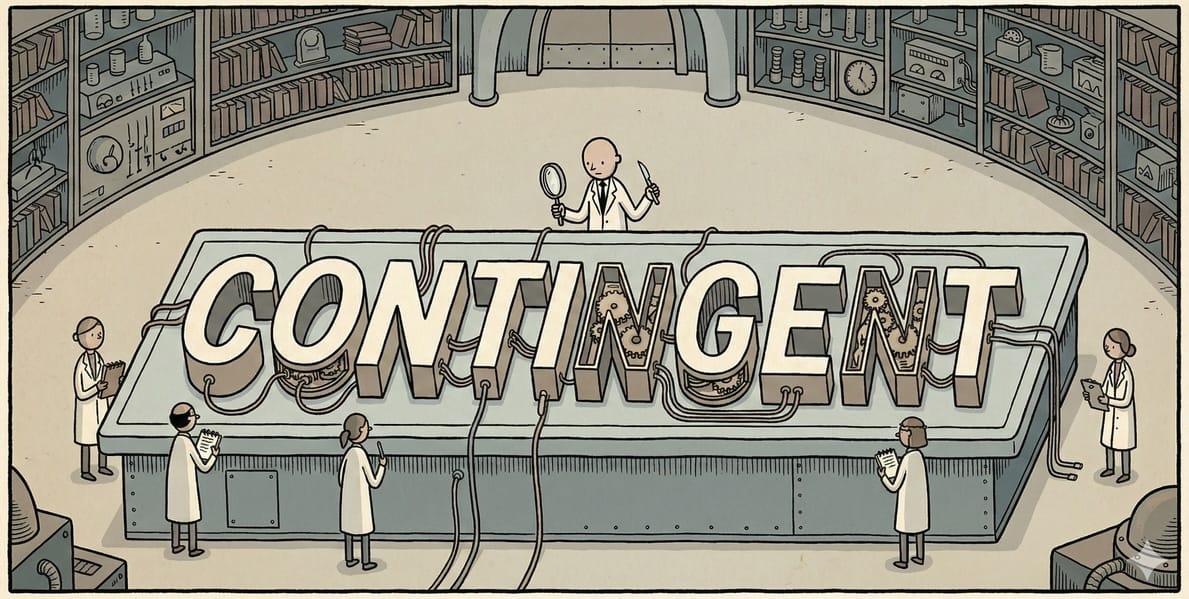
The language we use to describe workers reveals how we value them. And for nearly half the modern workforce, that language is causing strife.
Words are not neutral. They carry assumptions, embed hierarchies, and in corporate contexts determine who gets governed and who gets ignored. Few words have done more damage to workforce strategy than “contingent.”
Today, contingent workers represent somewhere between 20% and 49% of the average company’s workforce, depending on whose numbers you trust [Staffing Industry Analysts, 2025; Ardent Partners, 2023]. Yet the very word used to describe them - contingent - frames them as peripheral, conditional, and ultimately disposable. This is not accidental. It is etymological.
Understanding where the term came from, and why it stuck, explains much about the governance vacuum that now haunts every organisation attempting to manage a blended workforce.
From Latin-Touching to Corporate Dismissiveness
The word “contingent” derives from the Latin *contingere*, meaning “to touch” or “to befall.” Formed from *con-* (together) and *tangere* (to touch), the root idea is of something that may or may not “touch upon” reality: something conditional, uncertain, dependent on circumstances.
English absorbed the word around 1400, initially as an adjective meaning “dependent upon uncertain conditions.” The noun form arrived later, and by 1727 it had acquired a second meaning: a group assembled for a specific purpose, particularly in military contexts for troops contributed by an ally.
This dual meaning which is both “conditional” and “a group assembled” would later make “contingent workforce” a resonant phrase. When applied to workers, the conditional meaning dominated. These were not troops assembled for battle.
They were labour that might or might not be required, depending on circumstances beyond their control.
1985: The Birth of a Classification
The phrase “contingent work” entered workforce vocabulary at a 1985 conference on employment security. Its inventor was Audrey Freedman, a labour economist at The Conference Board, who used it to describe “conditional and transitory employment arrangements initiated by businesses to meet immediate labour needs” [Freedman, 1985; Polivka & Nardone, 1989].
Freedman’s coinage was precise and, at the time, accurate. She was describing something genuinely exceptional: workers hired only as needed, with no long-term attachment to an employer. In 1985, this was a minority arrangement—a deviation from the standard employment model that most workers experienced.
The term stuck. By 1989, the U.S. Bureau of Labor Statistics was formally defining “contingent work” as any job without an implicit or explicit long-term contract. Richard Belous, in his influential 1989 book *The Contingent Economy*, estimated 25-30% of American workers already fell into this category. “In the world of contingent work,” he wrote, “neither the worker nor the employer makes any commitments that last beyond sundown” [Belous, 1989; Washington Post, January 1989].
Note the framing. These workers are defined by what they lack: long-term contracts, job security, employer commitment. The word itself—contingent—reinforces this deficit model. Their employment is *contingent upon* business demand. They exist at the pleasure of circumstances.
Side Bar: the SIA lexicon paradox
We're not sure that the Staffing Industry Analysts Lexicon gets this right either - as each definition cross references "general terms" or "segments" or workers:
The Language Shaped the Governance
This might seem like semantics - it's not. The terminology Freedman introduced in 1985 did not merely describe a workforce category - it determined how organisations governed it. If contingent workers are, by definition, conditional and transitory, then investing in their management, development, or integration makes little strategic sense. Why build systems for people who may not be there tomorrow?
This is precisely what happened. As contingent work grew from exception to near-majority, governance structures failed to keep pace. HR systems were built for permanent employees. Procurement systems were built for supplies and services. Contingent workers fell into the gap between them; neither fully “talent” nor fully “vendor.”
The numbers tell the story. By 2023, the extended workforce had grown from roughly 20% of the average company’s workforce in 2010 to approximately 49% [Ardent Partners]. Yet most organisations still lack unified visibility into this population. They cannot answer basic questions: How many contingent workers do we have? What do they cost? What skills do they possess? Are they any good?
The language of contingency enabled this neglect. If these workers are merely contingent—conditional upon circumstances, here today and possibly gone tomorrow—then they do not require the same governance infrastructure as “real” employees.
Terminology Rebellion
Utmost Software was a well known workforce technology company acquired by Workday, declared that it “considers the term contingent as a pejorative, dismissive of the value of these workers” [TechTarget, 2021]. The company marketed an “Extended Workforce System” explicitly distinguished from traditional vendor management systems.
Beeline, a major VMS provider, launched its “Extended Workforce Platform” with similar reasoning. “We purposefully use extended workforce because it’s like extended family,” explained Senior VP Colleen Tiner [TechTarget, 2021].
Christopher Dwyer of Ardent Partners’ Future of Work Exchange advocates for “extended workforce” terminology “to encompass the agility, flexibility, and extended talent sources inherent in non-employee talent” [Future of Work Exchange, 2023].
The arguments against “contingent” are straightforward:
- It implies lesser status (the word literally means dependent on circumstances).
- It is absurd at scale (when nearly half your workforce is “contingent,” the term has lost descriptive value)
- It perpetuates procurement thinking (VMS systems historically managed by procurement treat workers “as a rate card” rather than as talent)
Alternative terms have proliferated. “Extended workforce” emphasises integration. “Blended workforce” emphasises strategic combination. “Agile talent” emphasises capability. “Total talent” describes an emerging management approach that refuses to segment workers by employment classification.
None have achieved the ubiquity of “contingent.” The word is embedded in SIA surveys, regulatory frameworks, academic literature, and four decades of HR practice. Changing it would require changing everything.
The Governance Consequence
Here is the uncomfortable truth: the terminology debate is not primarily about worker dignity or vendor marketing. It is about organisational blindness.
If you call a workforce segment “contingent,” you signal that it is conditional, temporary, and peripheral. You build governance systems accordingly or rather, you do not build them at all. You leave contingent workers in the gap between HR (which manages employees) and Procurement (which manages suppliers).
This gap has become a chasm. When contingent workers represented 5% of the workforce, the gap was manageable. When they represent 40-50%, it is an organisational mess.
Consider the metrics organisations track obsessively for permanent employees: engagement scores, performance ratings, skills inventories, career progression, span of control, retention rates. Now consider how many organisations track equivalent metrics for contingent workers. The answer, for most, is close to zero.
The terminology did not cause this governance failure. But it enabled it. It provided conceptual permission to treat a growing majority of workers as someone else’s problem.
Reclaiming the Noun
There is, perhaps, a path forward hidden in the etymology.
Recall that “contingent” acquired its noun meaning in the 18th century: a group assembled for a specific purpose, particularly troops contributed by an ally. This usage carries no connotation of inferiority. A military contingent is a valuable force, contributed strategically, integrated into a larger campaign.
If organisations could recover this meaning (a contingent as a purposeful assembly of talent, strategically deployed) the word might yet serve. The problem is not that contingent workers form a contingent. The problem is that organisations treat them as merely *contingent upon* circumstance.
The freelancer understood this four centuries ago. The mercenary knight who offered his “free lance” was not begging for work. He was providing capability that lords needed but could not develop internally. His independence was his value proposition.
Modern contingent workers occupy a similar position. They possess skills organisations need but cannot or will not develop in-house. They provide flexibility that permanent headcount cannot match. They are, in the military sense, a contingent: a force contributed to achieve specific objectives.
The question is whether organisations will govern them accordingly or continue to let them languish in the gap between systems designed for someone else.
Words Have Consequences
Audrey Freedman coined “contingent work” in 1985 to describe something genuinely exceptional. Four decades later, the exception has become the rule. What was once a small segment of conditional workers is now approaching half the workforce.
The word no longer fits the phenomenon it describes. Worse, it actively misleads. It frames strategic talent as peripheral dependency. It provides conceptual cover for governance neglect. It perpetuates the HR-Procurement divide that leaves millions of workers invisible to the organisations they serve.
“Contingent” placed power with circumstance and, by extension, with organisations that never had to think too hard about workers who might not be there tomorrow.
Tomorrow has arrived. Nearly half the workforce is now contingent. The question is no longer whether these workers matter. It is whether organisations will develop the language adequate to that reality. The etymology suggests they have not yet done so.