Enterprises & Freelancers 🤔
Enterprises represent only a small slice of freelance marketplace revenue. Why?
Three years ago, I met with Sean Rintel and Suri Siddharth from Microsoft Research about a paper they wrote in 2020 outlining the difficulty in Enterprises hiring or using freelancers. I encourage you to read it directly.
The Middle-Management Muddle
For years, the prophets of the "gig economy" have promised a friction-free nirvana where talent is summoned as easily as a ride home from the pub. For the modern corporation, the allure is obvious: why endure the bureaucratic torment of staffing agencies - with their weeks-long lead times and invoices resembling the GDP of a small nation - when an algorithm can fetch a graphic designer in Manila by lunchtime?
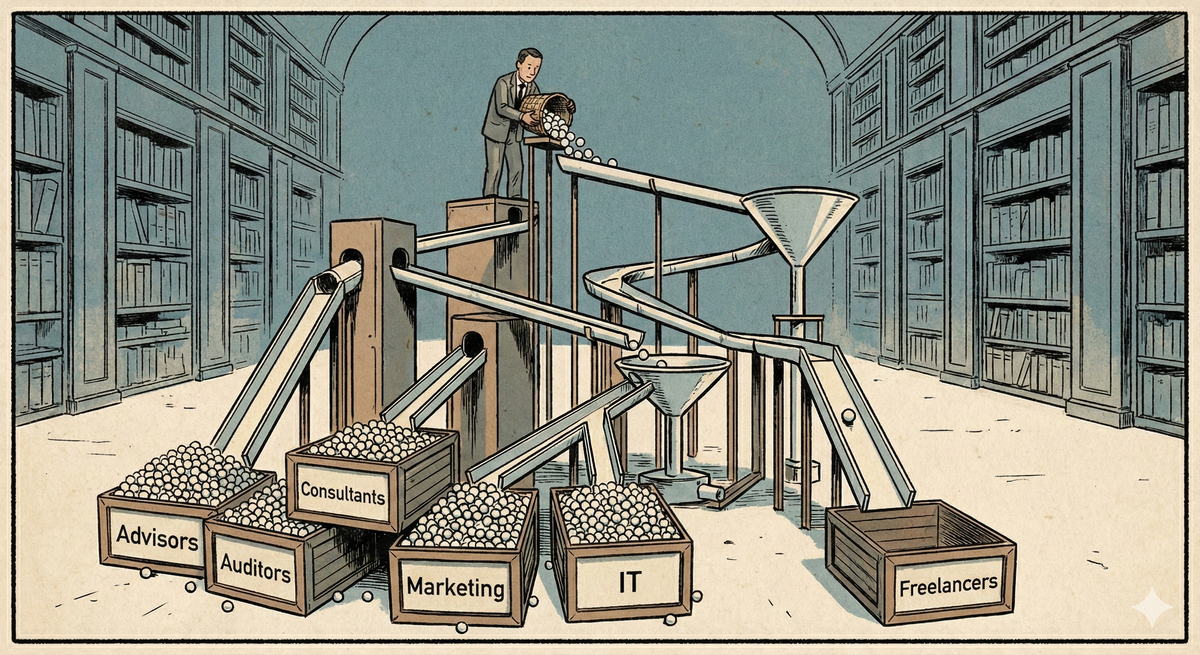
Alas, as with most free lunches, the bill arrives eventually, though not always in dollars. A study by researchers at Microsoft and the University of Washington reveals that while platforms like Upwork may strip away administrative friction, they do not so much remove the burden of hiring as dump it unceremoniously onto the desks of individual employees. These corporate worker bees, previously insulated by layers of HR and procurement, now find themselves "stuck in the middle," acting as one-person legal, ethical, and managerial departments.
The first hurdle is the "task definition problem," a delightful paradox where employees must precisely describe work they are often unqualified to perform. It is a common tragedy: a non-technical marketing manager needs a website built, but possessing no coding skills, cannot distinguish a Python script from a python snake. Consequently, they must "pray to get what they expect," often discarding the result and blaming themselves when the "tunnel effect" yields a product that resembles a bridge to nowhere.
Then there is the ethical vertigo of global arbitrage. Managers, ostensibly tasked with saving money, find themselves paralyzed by the "race to the bottom". When a bid arrives from Bangladesh for $5 and one from France for $5,000 for the same task, the corporate client is left wrestling with a moral calculus for which business school ill-prepared them. "It’s not slavery," one employee mused, "but there is something missing in the story here". Lacking guidance on what constitutes a "fair" global wage, they oscillate between fiscal prudence and post-colonial guilt.
Managing these invisible legions brings its own headaches. Corporate legal teams, terrified of misclassifying freelancers as employees, issue vague edicts that discourage "management" altogether. The result is a manager who desperately wants to course-correct a floundering project but fears that asking for a weekly status update might trigger a lawsuit. They are left to manage by telepathy, hoping the freelancer intuits the firm’s unspoken norms and brand voice.
Despite these transaction costs (the "overhead" of the mind rather than the ledger) the addiction to speed remains potent. Employees still prefer the "wild west" of the platform to the glacial pace of internal hiring. Yet, if corporations wish to avoid burning out their staff with the cognitive load of a procurement officer, they might consider providing "guardrails" rather than just a credit card.
Until then, the frictionless future of work looks remarkably like hard work.